
7 Ways to Prevent Mold After Water Damage in Your Atherton Home
Quick Answer
Preventing mold after water damage requires beginning professional drying within 24 hours of intrusion, maintaining indoor humidity below 50 percent, removing saturated building materials promptly, and scheduling a clearance test when drying is complete. Bay Area humidity accelerates mold growth, and mold can establish in as little as 24 to 48 hours.
Mold prevention after water damage in Atherton homes is a matter of timing, humidity control, and knowing which materials are most at risk in the specific construction types common in this community. We cover the full range of prevention work in this guide, from the first actions to take in the hours after a water intrusion event through the final clearance test that confirms your property is clean and dry. Atherton homeowners and property managers throughout the Peninsula can apply this knowledge to any water damage scenario, whether it comes from a burst pipe, a storm, an appliance failure, or any other source that leaves building materials wet for more than a few hours.
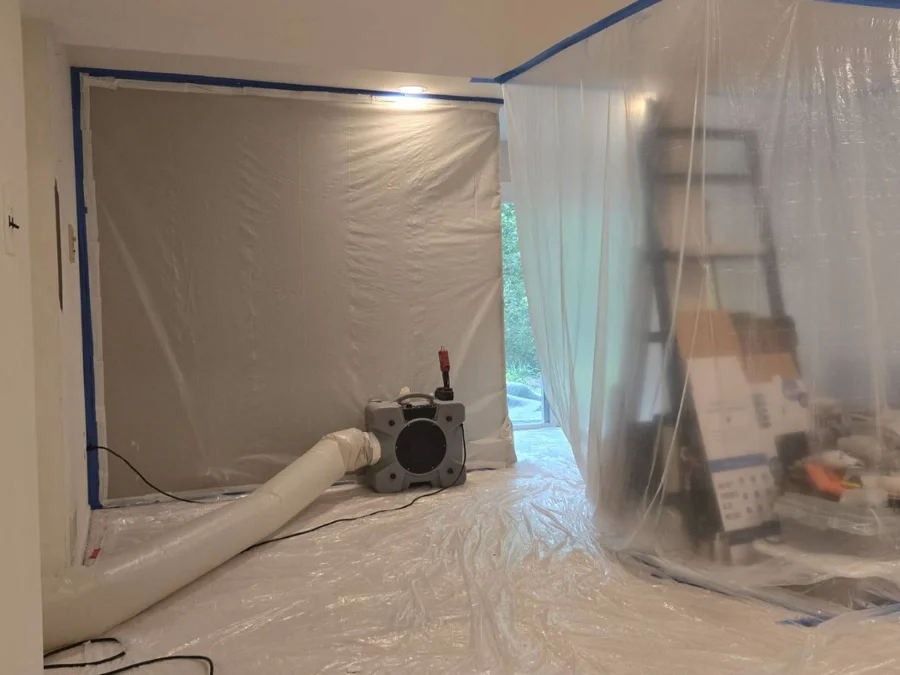
Industrial dehumidifiers are essential for preventing mold after water damage. Consumer units do not provide sufficient capacity for structural drying.
1. Begin Drying Within 24 Hours of Any Water Intrusion
The 24-hour window is the most important number in water damage response. Under Bay Area conditions, with ambient humidity regularly above 60 percent during Atherton’s rainy season from November through March, mold spores present in the air can begin colonizing wet materials within 24 to 48 hours of saturation. This is not a worst-case scenario. It is a reasonable expectation based on the humidity levels and organic material content of standard building materials. Beginning professional drying immediately after any water intrusion is the single most effective mold prevention measure available. Waiting to see whether mold develops before acting is the same as waiting to see whether a fire spreads before calling the fire department. Our water damage restoration team can be on-site in Atherton within two hours of your call.
2. Use Professional-Grade Dehumidifiers, Not Consumer Units
Consumer dehumidifiers are not restoration equipment. A residential dehumidifier typically removes two to three gallons of moisture per day under moderate humidity conditions. A commercial LGR (Low-Grain Refrigerant) dehumidifier used in professional restoration removes 100 to 150 pints per day under the same conditions. That is a difference of roughly an order of magnitude in moisture removal capacity. The goal of structural drying is not simply to reduce visible moisture. It is to bring the moisture content of building materials down to specific target levels measured in percentage points by material type. Consumer equipment does not provide the capacity, the instrumentation, or the monitoring capability to achieve those targets reliably. Using consumer dehumidifiers after a significant water event extends the drying time dramatically and in most cases fails to prevent mold in wall cavities and sub-floor spaces where air circulation is limited.
3. Remove and Dispose of Saturated Building Materials Promptly
Some materials cannot be dried effectively in place. Drywall saturated with water swells, loses structural integrity, and becomes a substrate for mold within 24 to 48 hours. Standard building insulation absorbs water and holds it against adjacent structural materials, extending drying time indefinitely if not removed. Carpet and carpet padding that have been saturated with Category 2 or Category 3 water must be removed and disposed of because the contamination cannot be reliably eliminated. The EPA’s mold guidance at epa.gov/mold includes specific recommendations on when materials should be removed versus dried in place. For Atherton homes with higher-end finishes, the decision about what to remove is made carefully with an eye toward what can be legitimately restored versus what creates ongoing mold risk if retained. When in doubt, removing the material and replacing it after drying is complete is the lower-risk choice.
4. Test Humidity Levels Daily and Target Below 50 Percent
Mold growth in structures is directly correlated with relative humidity. At indoor relative humidity above 60 percent, most common mold species can grow on organic materials with sufficient moisture content. At below 50 percent, mold growth is significantly inhibited. During a drying project, we monitor both ambient relative humidity and the moisture content of structural materials at multiple measurement points daily. The ambient humidity reading gives a general picture of conditions in the space. The material moisture readings confirm whether the structural components are reaching the IICRC-defined drying targets. Both matter. A space can register acceptable ambient humidity while wall cavities and sub-floor spaces remain too wet to close. Daily monitoring with professional moisture meters is not optional for effective mold prevention after a significant water loss.
5. Pay Attention to Areas Hidden Behind Walls and Under Flooring
Mold prevention fails most often in the spaces that are not visible. Water that enters a structure through a supply line leak, a roof breach, or storm flooding migrates into wall cavities, under flooring, into sub-structural spaces, and in some Atherton homes with complex floor plans, into areas that are genuinely difficult to access for inspection. Thermal imaging cameras allow us to see temperature differentials through wall surfaces that indicate moisture presence inside the cavity without opening the wall. Moisture meters with penetrating probes measure water content in wood framing and drywall at depth rather than surface level. These tools are how we find the water that surface inspection misses. In older Atherton construction with plaster over wood lath, moisture assessment is particularly important because the dense wall assembly slows both water migration and evaporation.
6. Know When to Call a Professional Instead of Handling It Yourself
Some water events are genuinely manageable with careful DIY response: a small appliance drip discovered immediately, a toilet overflow contained to tile flooring, a minor roof leak dried within hours. What determines whether DIY is adequate is the volume of water, the category of water, the materials affected, and the duration of saturation. For anything that involved more than a few gallons of water, that reached porous materials like drywall or wood, that was not discovered for more than a few hours, or that originated from a potentially contaminated source (toilet overflow, backed-up drain, storm flooding), professional restoration is not optional for mold prevention. The cost of professional drying on a moderate water loss is a fraction of the cost of mold remediation in a structure where drying was inadequate. The EPA recommends professional remediation for mold growth covering more than 10 square feet. Getting professional drying right the first time means that threshold is never reached.
7. Schedule a Clearance Test After Drying Is Complete
A clearance test is an air sampling test conducted by an independent industrial hygienist or certified mold inspector after a drying or remediation project is complete. Air samples are collected inside the treated area and compared to outdoor reference samples. If indoor spore counts are within an acceptable range relative to the outdoor baseline, the area passes clearance. If not, additional drying or remediation is required. The clearance test matters because it gives you independent confirmation that the work was effective. You are not relying on the word of the contractor who did the drying. You have a third-party document that says the property passed a standard air quality test. For Atherton homeowners with high-value properties, this document is worth having. It supports the insurance claim, protects against future disputes about whether a previous water event caused subsequent mold, and confirms that the structure is safe to close back up after restoration is complete.
Frequently Asked Questions
Professional drying equipment typically runs continuously until all monitored materials reach their target moisture levels, which on a moderate water loss in a standard building assembly takes three to seven days. The equipment is monitored daily and adjusted based on readings. Running equipment for a fixed time period without monitoring material moisture levels does not confirm that drying is complete. Only moisture meter readings at all monitored points reaching target levels confirm completion.
No. Painting over wet drywall does not seal the moisture in. It prevents the drywall from drying while creating a surface that appears normal. Moisture continues to migrate and mold grows behind the paint film. Drywall that was saturated must be allowed to dry completely, with moisture meter readings confirming it has reached target levels, before any painting. If the drywall was saturated to the point where it has lost structural integrity or was exposed to contaminated water, it should be replaced rather than dried in place.
Direct fog intrusion into well-maintained homes is not a typical mold source. However, the elevated ambient humidity that comes with coastal and Bay Area fog patterns does contribute to conditions that make mold easier to establish when a water intrusion event occurs. Homes in Atherton and surrounding Peninsula communities that have chronic minor moisture issues, such as under-ventilated crawl spaces or attics with inadequate vapor barriers, can develop mold problems over time from elevated ambient humidity without a single acute water event. Annual crawl space and attic inspections are worth doing in this climate.
In order of risk: paper-faced drywall is the highest risk material in a typical Atherton home because mold grows readily on the paper facing. Standard building insulation retains moisture and supports mold if not removed and dried quickly. Wood framing, particularly in older construction, absorbs and holds moisture and can develop mold on its surface. Carpet and carpet padding are high risk and typically non-salvageable after significant saturation. HVAC ductwork that collected water or high humidity air during the event is a secondary risk that develops over days rather than hours but must be assessed.
Our Service Area
We serve Atherton, CA and a 50-mile radius including the following communities: